It begins with the drop
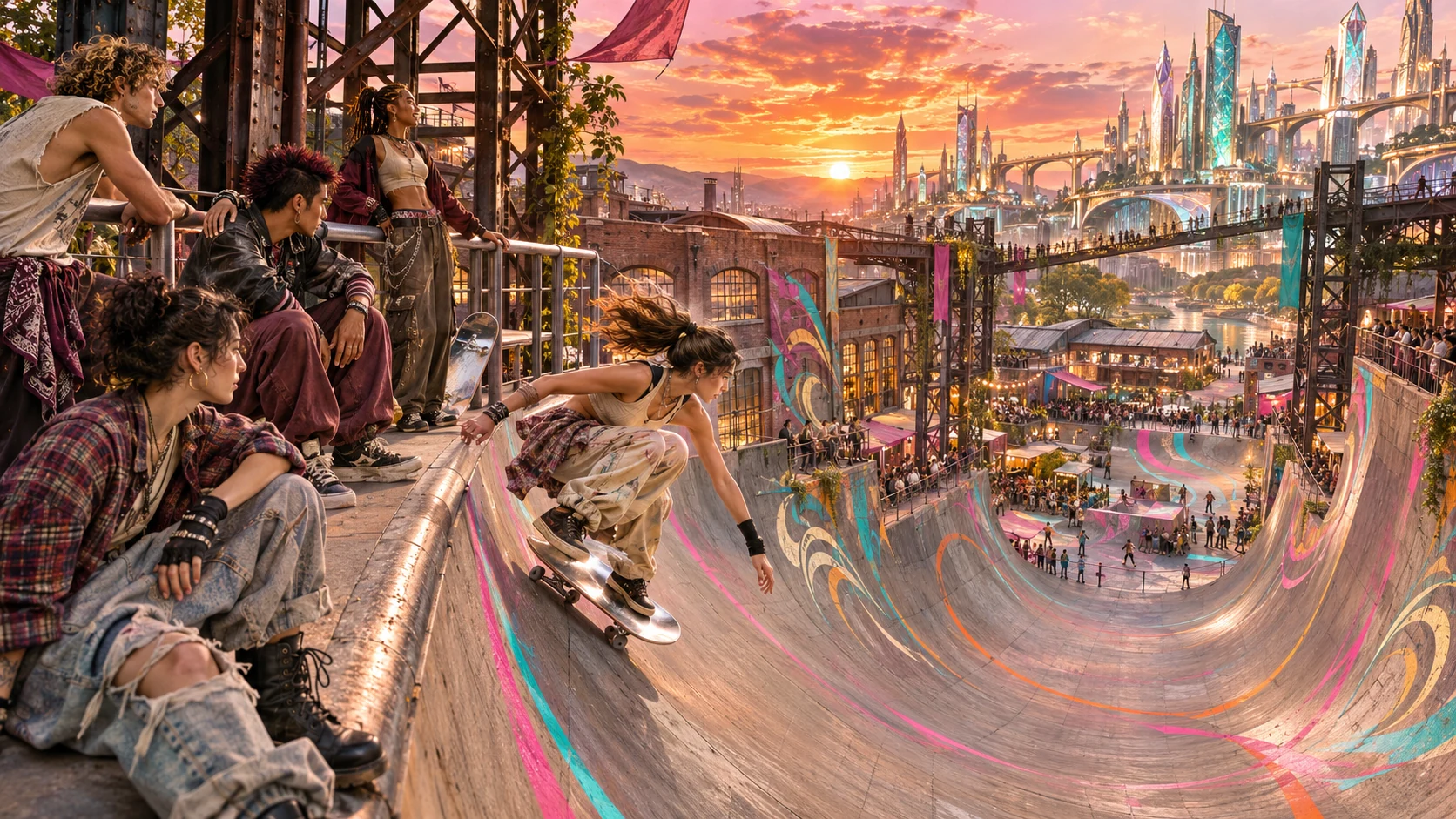
From the pavement, the great half-pipe is beautiful. From its upper platform, roughly thirty-five metres above the curve, it becomes a rather more personal proposition. Below the steel grating, rubber-streaked concrete sweeps through a valley of colour. The glowing graffiti is part of the landscape: orange, pink and electric blue tracing the skate-ways and the lines into a run.
The drop is a beginning. Watch a professional build speed, cross the opposite lip and carry that momentum into the structures beyond. A familiar city briefly acquires an entirely different geography. Spectators have the considerable advantage of enjoying this discovery with both feet on the ground.
A city worn, not merely visited
Erutia draws freerunners from across the Six Kingdoms. Around the sports district, team colours mingle with torn designer denim, street-racer jackets, flat boots and luminous scarves. The equipment has marks on it. The concrete has history. Someone beside you will almost certainly have an opinion about the run you have just watched.
Come for an organised course or simply to watch the drop-in gate. Official routes offer a shared language of lines and turns; unofficial ones belong to a less accommodating conversation between athlete, architecture and owner. An impressive cast on the Lattice is not evidence of permission.
Know your Quicksilver
Quicksilver equipment responds to athletes able to amplify their own movement through magic. It can take the form of a rideable board, provide brief contact against a vertical surface, or open in the air into a sail or a configuration that slows a descent. The skill lies in the transition: choosing what the next moment requires and making the body follow.
LiquidMetal, ShimmerGrip, EdgeTheory and GravityWell light the district's sponsor banners. Take time to study the equipment, but remember that its transformations support a caster's proficiency. They do not supply it.
Find the surface.
A board beneath your feet. Body, momentum and casting working together.
Borrow a wall.
Brief adhesion gives movement another direction. The contact does not last forever.
Shape the air.
Open the material into a sail and make the next part of the run airborne.
Let the fall breathe.
A parachute configuration slows descent. The athlete still chooses the moment.
The argument after the applause
How much advantage should equipment provide? When does an augmentation become the performance? You will hear both questions wherever freerunners gather. Some celebrate every new possibility; others prize the discipline of an unmodified body. Most agree that a remarkable run deserves another look.
For a first visit, start as a spectator. Follow one athlete from the gate through the route, rather than trying to watch the entire district at once. You will soon understand why the crowd sometimes goes quiet just before it erupts.